
Create DB cluster snapshot
You must have AWS Account Linkage version 4.0 or higher to run this job. Please see the following page for information on updating permissions.
Update your linked AWS account to use new features
Supported DB engines are Amazon Aurora MySQL and Amazon Aurora PostgreSQL. Amazon Aurora Serverless is also supported.
See “Create DB snapshot” on creating DB snapshots except for Aurora.
The procedure for creating a task is as follows.
- From the header menu, click “TASK” - “RDS(Aurora)” - “Create DB cluster snapshot”.
- A list of tasks will be displayed. Once you have created a task, you can edit or delete it from this screen. At first, there are no tasks, so click the CREATE button.
- Enter the conditions and click the CREATE button.
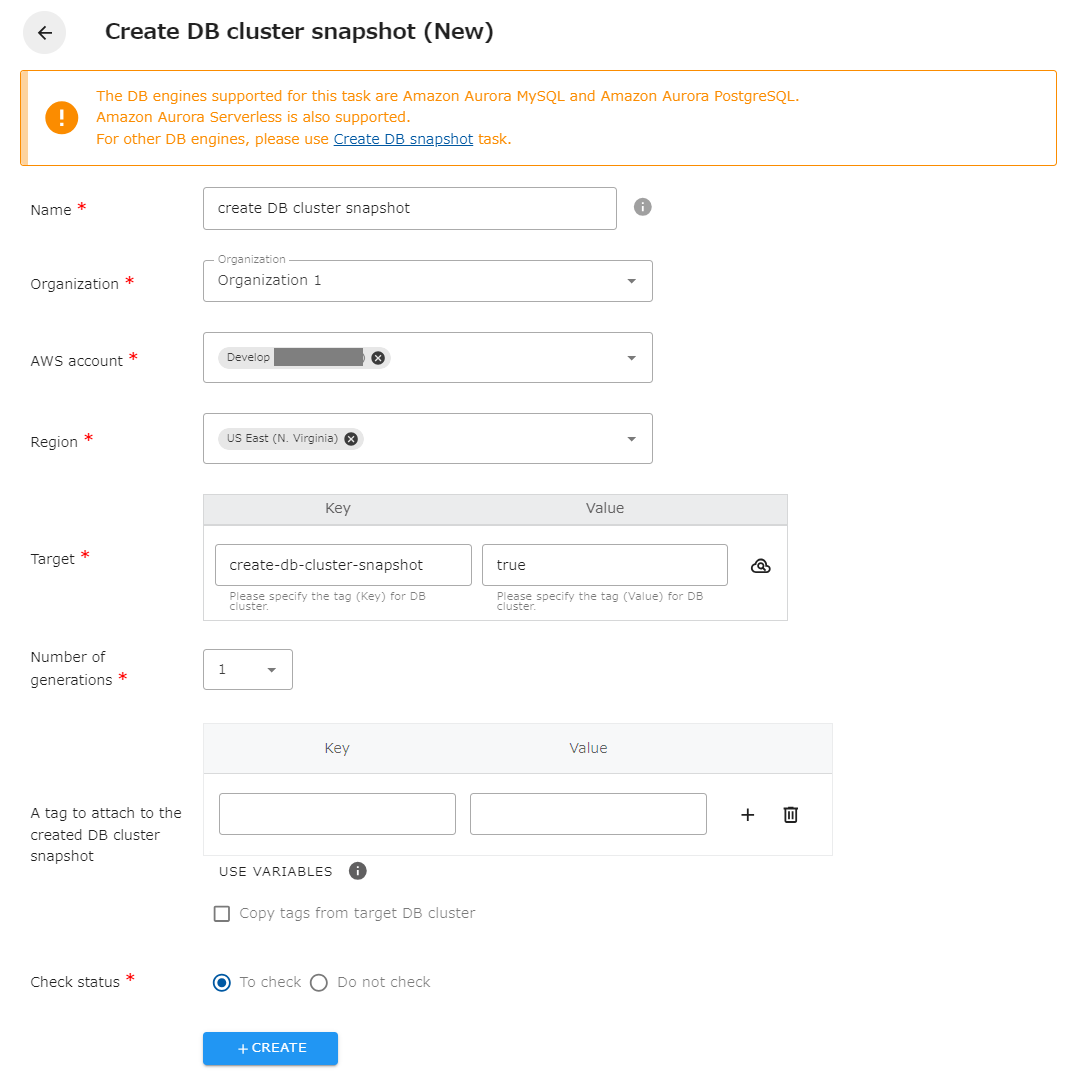
The following is a description of the items on the screen.
| Name | The name of the task. |
|---|---|
| Organization | Specify the organization. Members of the same organization can browse and edit. |
| AWS account | Linked AWS accounts will be displayed. Select the target AWS account. |
| Region | Select the target region. |
| Target | Specify the tag (Key and Value) of the DB cluster for which you want to perform the operation. You can set the same tag for multiple DB clusters to create a DB cluster snapshot at once. |
| Number of generations | Specifies how many old DB cluster snapshots to keep. If there are already as many DB cluster snapshots as the number of generations, the oldest one will be deleted upon creation. |
| A tag to attach to the created DB cluster snapshot | Set tags to be attached to the created DB cluster snapshots. |
| Check status | Checks the status of the created resource. If checked, success is considered when the created resource is completed. If not checked, success is considered when the API returns a successful response. |
Variables that can be used to tag the DB cluster snapshots you create
Section titled “Variables that can be used to tag the DB cluster snapshots you create”You can use variables to set values for the tag Value. The available variables are as follows.
| Variables | Description |
|---|---|
| ${target_id} | Set the target ID. |
| ${execute_date} | Set the job execution date. Example: 2024-03-26 |
| ${execute_datetime} | Set the job execution date and time. Example: 2024-03-26_0530 |
| ${task_name} | Set the task name. |
| ${job_name} | Set the job name. |
Limit of tags to attach to created DB cluster snapshots
Section titled “Limit of tags to attach to created DB cluster snapshots”The maximum number of tags that can be attached to a created DB cluster snapshot is 50. If you try to attach more than 50 tags when executing a job, an error will occur. db_cluster_identifier, cm-Task, and creation_info tags must be attached to the DB cluster snapshot creation task. Please be careful not to exceed 50 tags together with the tags to be copied and the tags specified in the task’s configuration screen.
Regarding generation management of created DB cluster snapshots
Section titled “Regarding generation management of created DB cluster snapshots”The DB cluster snapshot created by the job has a tag cm-Task. The value is the name of the task that created the DB cluster snapshot. Generation management is performed in DB cluster snapshots that have the same DB cluster from which they are backed up and the same value of the cm-Task tag. DB cluster snapshots created by another task or manually created DB cluster snapshots are not deleted by job generation management.
Please note that if the task name is changed during operation because the task name is used for generation management, DB cluster snapshots created prior to the task name will not be subject to generation management.
DB cluster snapshots without the cm-Task tag will not be deleted by the job, so if you want to keep the DB cluster snapshots you created, delete the cm-Task tag.
Note that DB cluster snapshots created by older versions of opswitch have the tags “cm-Job” and “db_instance_identifier” instead of “cm-Task” and “db_cluster_identifier” tags. Those DB cluster snapshots will be subject to generation management after migrating to the current version of opswitch.
Regarding the restoration of created DB cluster snapshots
Section titled “Regarding the restoration of created DB cluster snapshots”If you want to restore from the DB cluster snapshot you created, please login to the Management Console and restore from the RDS screen. The documentation on the official site is as follows
Restoring from a DB cluster snapshot
The task to create a DB cluster snapshot will result in an error if it is performed on a stopped DB cluster. This is an AWS specification, so the same error occurs when trying to create the task in the Management Console. Please execute the task on a running DB cluster.